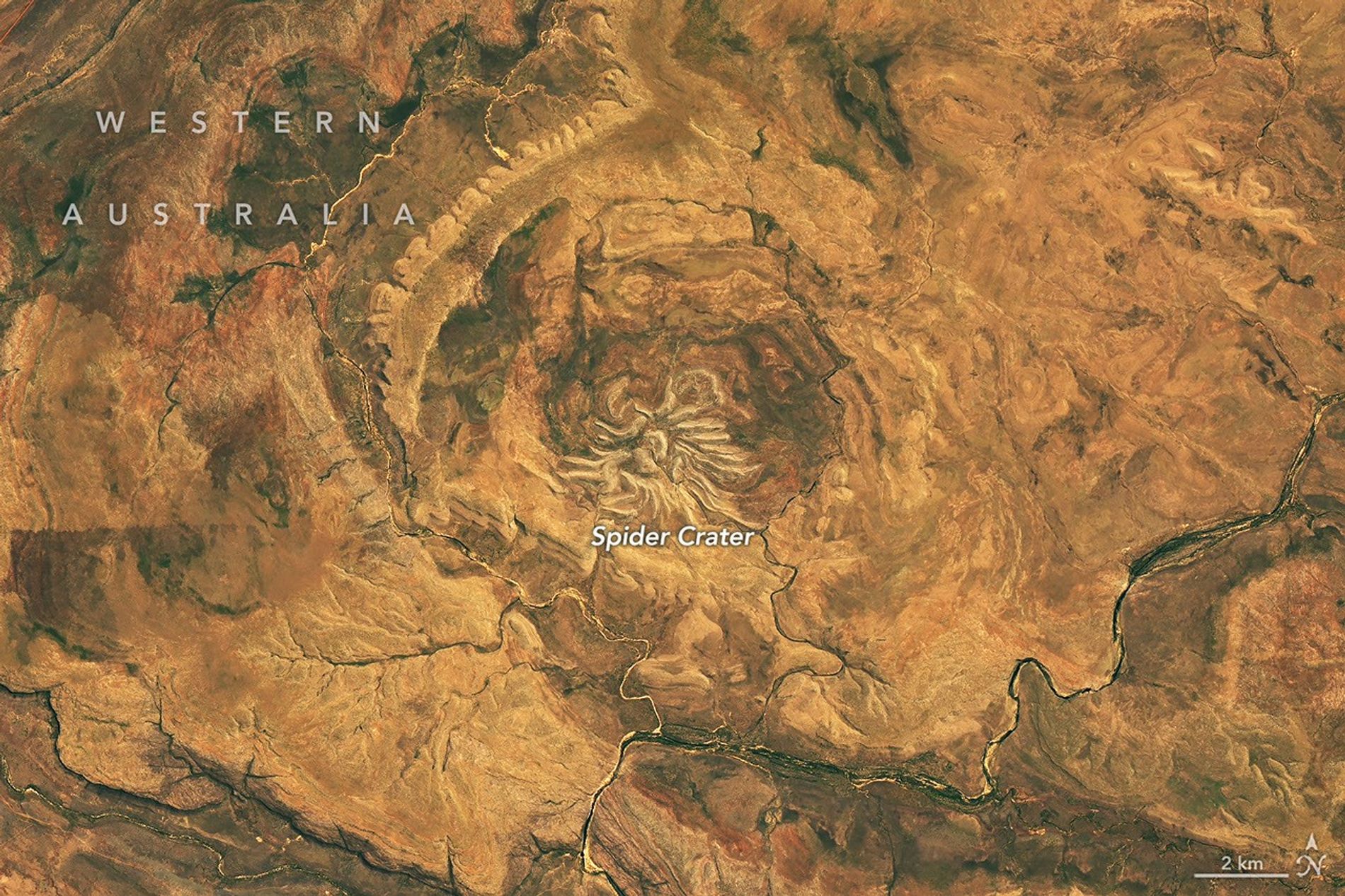
NASA has released a Landsat 9 image of Spider Crater in Western Australia, an ancient impact structure shaped by erosion over hundreds of millions of years. Geologists say its centre shows the remains of a rebound uplift and shock-fractured rocks.
01Summary
- 01NASA’s Landsat 9 captured the image of Spider Crater on 20 September 2026.
- 02The crater in Western Australia’s Kimberley region measures about 13 kilometres by 11 kilometres, with a central feature about 4 kilometres across.
- 03Geologists think the spiderlike pattern is a remnant of a central uplift formed after a meteorite impact.
- 04Shatter cones, shocked quartz and zircon crystals have been found there, supporting an impact origin.
- 05The impact is estimated to have happened between about 900 million and 600 million years ago.
02Why it matters
The crater gives scientists clues about how meteorite impacts deform rock and how erosion can expose ancient impact structures. It also helps researchers estimate the age and angle of a very old strike on Earth.
Pulse AIAsk about this story
Answers are generated by AI from the story summary; they are not investment, health or legal advice.